04/21/26
Data Driven: What Missouri Can Learn From Fast-Improving States
Missouri’s 2025 Annual Performance Report (APR) reveals a clear challenge: most schools are labeled “meeting expectations,” yet fewer than half of students are proficient in core subjects and achievement remains below pre-pandemic levels.
For the fourth consecutive year, The Opportunity Trust (OT) convened more than 100 education, civic, business, and philanthropic leaders at the annual Education Data Town Hall — not simply to review results, but to help the community interpret what the data is saying, understand what is working in fast-improving states, and identify what Missouri can do differently. The conversation centered on a shared understanding: improving student outcomes depends not only on classroom practice, but on clear expectations from policymakers and school boards, sustained support from community partners, and accountability systems that remain consistent over time.
Across four years of these convenings, a consistent lesson has emerged: progress begins with a clear-eyed look at the data, the courage to make changes, and the discipline to sustain them. This is the role OT plays — helping community leaders move from data awareness to shared strategy and action. Experiences in states like Mississippi and Louisiana reinforced that when policy, support, and accountability align, educators can focus on fundamentals — early literacy and middle-grade math — and results improve.
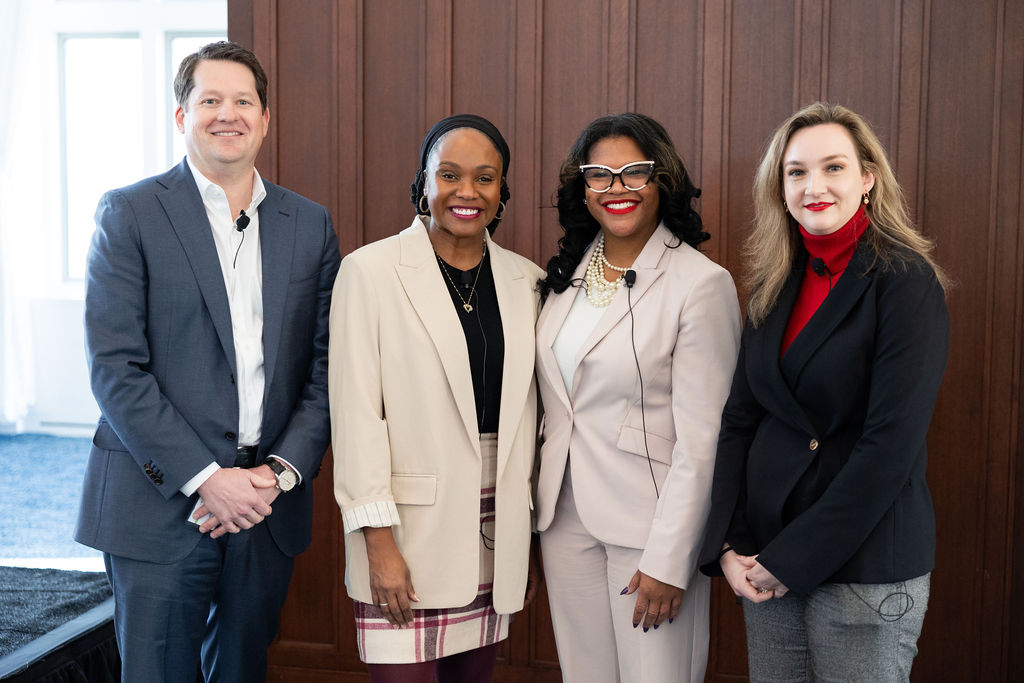
Following a presentation on the 2025 MAP results, a panel moderated by John Kemper (Commerce Bank) featured Rachel Canter (Mississippi First; Progressive Policy Institute), Kira Orange Jones (Louisiana State Board), and Dr. Bonita Jamison (Superintendent, Maplewood Richmond Heights). Panelists emphasized honest data, transparent accountability, and sustained leadership focused on long-term outcomes.

The Missouri assessment results confirmed a difficult reality: student achievement has changed little in recent years. On the National Assessment of Educational Progress — the only measure allowing state-to-state comparisons — Missouri ranks approximately 40th out of 50 states in fourth-grade reading when adjusted for demographics. Black students scored 32 points below white students in fourth-grade reading, and economically disadvantaged students scored 29 points below their peers. Fourth-grade math scores improved modestly but remain below pre-pandemic levels, and Missouri was one of only a handful of states where eighth-grade math scores actually declined between 2022 and 2024.
The discussion centered on third-grade reading and eighth-grade math — milestone indicators strongly predictive of graduation and long-term success. As Rachel Canter noted, “Missouri’s data looks almost identical to national trends on NAEP over the last 20 years — some progress in the early 2000s, a leveling off, and then a deep decline since the pandemic.”

How Fast-Improving States Use Data Differently
Mississippi and Louisiana offer a clear contrast to Missouri’s trajectory. Both states rebounded more quickly after the pandemic in early literacy and middle-grade math, and Louisiana has sustained improvement in fourth-grade reading for more than two decades. For OT, these are practical case studies — helping local leaders focus on the policies, supports, and accountability practices most likely to move student outcomes in Missouri.
Panelists emphasized that these gains were driven by accountability systems that prioritized growth toward proficiency, not just growth relative to peers. “Every single day for a decade, we’re getting really specific about what levers drive the most progress,” said Kira Orange Jones.
Canter argued that improvement depends on using data honestly. “The most important thing is not retreating when the data is hard, but figuring out what it’s telling you and responding to it. If you retain students in the same classrooms with the same systems, outcomes will not improve.”

Local Evidence and the Path Forward
The Town Hall highlighted two local systems working in partnership with OT that demonstrate what sustained alignment produces. At Maplewood Richmond Heights, the percentage of economically disadvantaged students scoring “Below Basic” in ELA dropped 12 points. Premier Charter School posted similar gains. These results reflect the conditions OT works to build: strong governance, data-driven leadership, and consistent evidence-based practice.
Missouri’s challenge is not a lack of information, but a lack of alignment between data, policy, and investment. That gap is why OT is actively supporting HB 2710, legislation that would add an A-F school grading system to Missouri’s existing accountability framework — giving families, funders, and policymakers a clearer picture of school performance than the current APR provides. The Missouri Education Data Explorer (MEDE), built and maintained by OT with support from the U.S. Department of Education, and our Town Hall booklet, Missouri Assessment Results: Academic Trends in St. Louis, are designed to make that data accessible and actionable for anyone seeking to invest in what works.
For four years, OT has convened this community around a simple premise: that honest data, consistently acted on, is what separates systems that improve from those that don’t. That premise is becoming a track record — in the accountability reforms taking shape in Jefferson City and in the proof points lifted up here year after year. The work is far from finished.